Friday, July 21, 2017

Wood Chip Mulch is Magic on Desert Soils

Using organic mulch, and its importance when applied to desert soils, is frequently misunderstood and overlooked. I remember 20 years ago approaching woody plant professionals in the Las Vegas Valley if they would participate in a mulching study with fruit trees. The proposal was to divert green waste from landscapes, all of it from our urban forest, away from landfills and applied to the soil surface of a newly established University Orchard.
Mulch additions and fruit tree growth after platting

The University Orchard was developed as a demonstration facility, in a partnership with Dave Wilson Nursery, focused on evaluating fruit tree variety performance under Mojave Desert conditions. All of the fruit trees grew well in their early years but there was a general consensus they might perform better if organic surface mulches were used.
Wood chip mulch added to new orchard

Organic mulches were difficult to find in desert communities back then. When you did find wood mulch it was expensive and typically imported as a forestry byproduct. The idea of using community green waste was not popular at that time. Instead, green waste was buried in landfills.

Viragrow 'Gorilla Hair' mulch

One local professional, Tony Valenti owner of First Choice Tree Service, contacted me privately and said he was interested in participating. The first loads of chipped trees that came from Tony gave us lots of flat tires. Tony worked with us to eliminate Mesquite from the mix. We could live with the pine cones but not Mesquite thorns.
The next trees eliminated were palms. Chipped palm, particularly the petioles of the fronds, decomposed too slowly under our desert conditions. Trees containing borers, our worst insect fear, were sent through the chipper and the borers, as well as their homes, were totally destroyed.
We intentionally chipped wood containing active borers. They were demolished during the chipping process.
We have fewer plant disease problems in desert communities than plants grown in communities from wetter climates. In 20 years we have never experienced disease problems coming directly from mulch applied to the Orchard floor. However, collar rot can be a problem with young trees if wood mulch is in direct contact with their trunks. Tree collars, used to protect young trees from rabbit damage, were very effective at keeping wet mulch away from tree trunks.
Bubbler and basin irrigation of fruit trees
Irrigation at the Orchard is either by bubbler with a basin around the tree or drip irrigation. In either case, if wet mulch was in direct contact with the immature trunk of fruit trees, collar rot, a deadly disease for young trees, can be expected. For this reason, wood mulch is kept away from the trunk of all fruit trees until they are in their fifth or sixth year. At that age, it seems there is enough maturity to the trunk to hold up against contact with occasionally wet surface mulch.
The amount of mulch applied to the soil surface has varied over the years from as little as 3 inches to as much as 6 inches or more. We have never had a problem with coarse wood mulch 6 inches deep covering the Orchard floor. In fact, I prefer to use coarse mulch applied deeply.
Orchard mulched with composted urban tree mulch, 4 to 6 inches deep.
What have we noticed when we apply wood mulch to desert soils? Wood mulches “dissolve” into desert soils at the rate of about one half inch per year. This required us to renew surface mulch about every three years. Fruit trees surrounded by wood mulches outgrew trees not mulched by at least 100% and in some cases 200%.
The top couple of inches of desert soils covered in mulch changes color from grey or light tan to a chocolate brown in a matter of one to two years. This is because of the increase in organic content as the mulches decompose. Soil texture changes. Surface soils that required digging with a pick, now could be scooped up with your hands. Earthworms appeared where none survived before.
When wood chip mulch is applied to the soil surface of desert soils the soil color and chemistry changes within weeks. This soils was light tan in color before mulch was applied to the soil surface.
Soil chemistry improved. Salinity was easier to manage because of improved water percolation through the soil and the flushing of soil salts. Boron, a common element in our desert soils and particularly troublesome to trees at very low levels, was bound by the increased organic content of the soil.
When wood mulch is applied all but the toughest weeds give up
The need for weed control, for all intents and purposes, was eliminated. Mushrooms would appear throughout the Orchard after our infrequent rains. Some were concerned about the appearance of mushrooms was a sign of mulch decomposition and soil enrichment. We could stretch irrigation intervals an extra day during the heat of the summer because soil moisture was conserved and surface evaporation was slowed.
Mushrooms like this is a good indicator sources of organic matter are decomposing. That's a good thing!
Problems? Outside of collar rot on young trees, not very many. We noticed an abundance of what I called as a kid, “boxelder bugs”. They would on occasion attack soft fruit and become a general nuisance due to their numbers. In the same regard, but not as much of a nuisance, there were roaches near irrigation boxes in the mulch litter.
Organic mulches conserve soil moisture, moderate soil temperature and reduce competition from neighboring plants. They modify the root and soil environment thus facilitating the penetration of water into the soil root zone. Organic mulches add organic matter to the soil as well as its breakdown products, humic and fulvic acids. Improvements to the soil chemistry interact favorably with plant nutrients found in the soil, lower soil alkalinity, encourage the development of earthworms and arthropods that thrive in these environments, reduce potential erosion, prevent soil compaction, along with a myriad of other benefits.
When mulch is placed in a landscape, more feeder roots tend to develop closer to the soil surface due to an improved soil and plant environment. This is partly due to more favorable root growth conditions due to mulch decomposition and partly because of suppression of deeper roots because of higher soil water content in the underlying soil.
Rock mulch on the soil surface is good for the first few years if the soil has organics in it but eventually, four to five years later, non-desert plants develop problems.

Inorganic mulches, such as rock mulch, provide some of the same benefits as wood mulch but do not contribute soil improvement since their breakdown products are not organic in nature. Rock mulches play a key role in reducing water losses from the soil due to the evaporation, controlling weeds, modifying soil temperatures, reducing soil erosion and reducing water runoff.
But rock mulches contribute to soil mineralization and the disappearance of soil organic matter. Even though soil amendments may have been mixed with the backfill at the time of planting, this soil organic content disappears in 3 to 4 years.
As soil organic matter disappears, the physical and chemical properties of the soil changes. Naturally occurring soil chelates, responsible for making minor elements such as iron available to the plants, disappear. Soil salts begin to accumulate because they cannot be flushed from the soil as easily. In short, non-desert plants intolerant of desert soils begin to yellow, leaves begin to scorch, plant canopies thin due to leaf drop and slower growth rates and plants are less tolerant to diseases and the harsh desert environment.
Organic mulches play a vital role in landscape plant health, particularly in mixed landscapes where desert and non-desert trees are grown together.

Viragrow Delivers!

Rock Dust Now in Viragrow Composts

Viragrow has been looking at rock dusts very carefully. We evaluated three of them recently in some trials conducted in Las Vegas, Nevada. Those we screened included Azomite, Kelzyme, Zeolite and compared them against a control. Viragrow made the decision to include Kelzyme in three of its existing composts; Tomato Lady Mix, Rejuvinate Soil Mix and BF Compost. We hope our customers will appreciate this addition.


Viragrow Delivers!

Construction Fill a Problem for Landscapes

Q. We recently purchased our house and in the process of installing our backyard.  Currently we are digging trenches for irrigation lines and very quickly finding out that this so called "soil" is in fact construction infill. The "soil" is comprised of dusty dirt and filled with rocks. Our landscape plans comprise of a small turf patch for our 1 year old daughter and our 3 year old dog, perimeter landscaping and a 18" wall off our patio for a small herb garden. We are have a very small yard and the finished landscape area, where soil will be placed, is only 365 square feet.  What do you recommend that we use in our yard to amend the infill and turn it into useful soil? And how much will we need? 


Viragrow's organic topsoil
A. What you are describing is pretty common in most urban residential settings in planned communities. This construction “fill” is junk and worse than our native desert soil. This fill will be okay for desert "flooring" of your landscape where there are no plants but will need to be replaced or amended in areas where you are planting in the ground, establishing a lawn or a vegetable area. By the way, you do not want to put soil with pointed rocks back in the trenches where there are irrigation lines. The soil beneath irrigation lines should also be free of rocks.

Another option is some contouring and elevation changes of your landscape with decent quality "topsoil". I am consulting with a company in Las Vegas, Viragrow, which has a source of local "topsoil" that is decent and can be used for elevation changes and contouring at a fairly reasonable price. I don't know of another company in town that would have anything this good for that purpose. The others all use “reject sand”. Reject sand is horrible stuff.

Viragrow's washed silica sand
You could also use soil mixes for doing the same thing but that will be more money. If you do any elevation changes to your landscape make sure the water that collects in your landscape in low spots after heavy rains does not enter the home. This is a desert but rain, when it occurs, can come down in torrents. Residential yards are required to have positive drainage from the backyards to the city streets and ultimately into storm sewers. This is to prevent flooding inside the home from happening during the storm events so make sure you contour/elevation changes address this problem.

If you are not doing any elevation changes and planting directly into your existing fill, excavate to the following depths for planting areas: 

  • flowerbeds and vegetable beds 12 to 15 inches, 
  • small shrubs and groundcovers 12 to 15 inches, 
  • larger trees and shrubs 18 to 24 inches, fruit trees 18 to 24 inches, 
  • lawns 12 to 15 inches, 
  • vines 12 to 15 inches


… Basically the larger the plant the deeper and wider you should excavate.

Garden Soil Mix, compost and silica sand
Holes in the soil for planting need to be deep enough for the roots of the plant going into the hole but much wider than the roots. Holes for planting woody plants should have a width 3 to 5 times their existing width. Remove rocks from the backfill going into the whole that are larger than a golf ball. If the soil removed from the hole is native desert soil, mix this soil 50-50 with 100% compost. Use this amended soil for planting. If the soil excavated from the whole is mostly rock then use a finished soil mix such as the Viragrow Garden Soil Mix for backfilling these holes. Viragrow Garden Soil Mix is a mix of silica sand and compost, not reject sand.

Flower beds and vegetable beds need to be excavated to the depth I mentioned above and filled with a garden soil mix if the soil cannot be amended with 100% compost. Like I said, if this is native desert soil and not fill you could amend this soil with 100% compost and it should be fine.

The amount you will need is a little bit tricky. You would need 12 yards to fill an area about 350 square feet to a depth of 12 inches. I'm not saying that you need to order this amount but this should give you some idea of your starting point and worst case scenario.

Order 100% or straight compost if you can mix it with native desert soil. If you cannot mix it then I would order Viragrow's Garden Soil Mix as a general mix for planting all of your ornamental plants, fruit trees and lawn. This soil mix can also be amended for vegetables. You can always add extra ingredients to this for your vegetable garden area or your flowerbeds if you need to.

Bob Morris, Consulting Horticulturist

Viragrow Delivers!

Tuesday, July 4, 2017

What's In Viragrow Compost?

Did you know that the fertilizer available to plants in Viragrow Compost would cost $229.41! These are plant nutrients not available in perlite, vermiculite, peatmoss and coconut coir!
Viragrow compost used in raised beds for vegetables

Fertilizer content in one cubic yard of Virago Compost                             Retail Cost
3.73 pounds quick release nitrogen equivalent to 17.6 pounds of 21-0-0        $22.34
7.2 pounds slow release nitrogen equivalent to 129 pounds of Milorganite    $107.50
15.13 pounds P205 equivalent to 33.6 pounds of 0-45-0                                 $ 45.40
1.5 pounds K20 equivalent to 2.5 pounds of 0–0–60                                       $   8.50
7.1 pounds sulfur equivalent to 7.5 pounds of water-soluble sulfur                $ 16.12
16.59 pounds iron equivalent to 83 pounds of iron sulfate                              $ 24.55
1.25 ounces manganese                                                                                    $  5.00 trace elements

Tuesday, June 27, 2017

Xtremehorticulture of the Desert: Desert Soils Need Organics Added!

Xtremehorticulture of the Desert: Desert Soils Need Organics Added!: Q. I'm planting new fruit trees this year. I've noticed there seems to be a consensus that backfilling should be done with only n...

Xtremehorticulture of the Desert: Fruit Trees and the Benefits of Wood Mulch

Xtremehorticulture of the Desert: Fruit Trees and the Benefits of Wood Mulch: Q. Could you provide me with a copy of the mulch trial you conducted on fruit trees several years ago? You randomly applied mulch to diffe...

Xtremehorticulture of the Desert: Compost and Steer Manure Not the Same on Lawns

Xtremehorticulture of the Desert: Compost and Steer Manure Not the Same on Lawns: Q.  Recently you recommended applying compost to lawns. I am confused if you mean steer manure. How often do you recommend doing this? When...

Xtremehorticulture of the Desert: Compost and Steer Manure Not the Same on Lawns

Xtremehorticulture of the Desert: Compost and Steer Manure Not the Same on Lawns: Q.  Recently you recommended applying compost to lawns. I am confused if you mean steer manure. How often do you recommend doing this? When...

Xtremehorticulture of the Desert: Viburnum Leaf Browning Probably NOT Spider Mites

Xtremehorticulture of the Desert: Viburnum Leaf Browning Probably NOT Spider Mites: What’s happening to my Spring Bouquet (Viburnum Tinus)?  It bloomed beautifully in the Spring for several years (including this past Sprin...

Xtremehorticulture of the Desert: Cana Lily Care in the Desert

Xtremehorticulture of the Desert: Cana Lily Care in the Desert: Q. What is the proper care for Canna lilies. Since they are a dominant plant in my landscaping here in Palm Springs, I'd like to know w...

Xtremehorticulture of the Desert: I Hate Resolving Disagreements

I Hate Resolving Disagreements about potting soil: Q. Please settle a disagreement between my wife and me. Each spring my wife plants several plants in pots for our patio using bagged pottin...

Tuesday, June 13, 2017

Are Organic Fertilizers Really Organic?

The organic movement has a foothold in the turfgrass and ornamental industry. The same industry brewing for decades in home vegetable gardens, and then with small-scale producers, has emerged as a significant market percentage for commercial landscapers. Homeowners are asking for “organic” landscape plants, organic methods of controlling pests and applications of “organic” fertilizer to their landscapes.


            Alternative methods for producing and maintaining ornamentals and turfgrass have been around for a long, long time. In the past, very few residential clients were willing to pay for the additional costa associated with the product. That may be changing thanks to local food movements and organic agriculture1. The word “organic” has become synonymous with “wholesome” and “safe”.
Technically, manufactured urea fertilizers are "organic" but not certified organic
            Organic has a different meaning in landscape horticulture industry. Organic can mean sources that are not synthetic or conventional. Organic amendments, such as municipal and animal sources of biosolids, can be applied to improve soil physical and chemical properties which in turn can improve turfgrass establishment rates, growth, and quality. We know, for instance, that in poor or marginal soils the incorporation of compost improves soil properties, increases soil nutrients and consequently improves plant growth. In soils with a naturally higher percentage of organic matter these improvements are less noticeable.
EZ Green Composted chicken manure we carry is "organic" and certified organic
            Research at Colorado State University evaluated the effects of applying composted dairy manure as topdressing to Kentucky bluegrass. Researchers applied compost at the rates of 13.3, 26.6 and 40 cubic yards to the acre. Applying composted manure as topdressing to established bluegrass in 2003 through 2004 improved the soil’s physical properties and nutrient content.

Effects of Compost Topdressing on Turf Quality and Growth of Kentucky Bluegrass

            Although nothing new, the application rates are important. The two higher rates improved turfgrass overall quality and allowed the grass to retain color in the fall, early winter and green up faster in the spring. Not bad for a product that is not considered a fertilizer.
This composted dairy manure from Amargosa Valley is organic but not "certified organic"
            During the hot summer months the two higher application rates produced about 50% more clippings. The researchers concluded that compost improves turf quality and shoot growth via its action as a slow-release fertilizer.
            More turfgrass clippings sound like a potential landscaper’s nightmare but there is a positive side to this “problem”.  Increased amounts of clippings in summer months helps suppress the incidence of hot weather diseases. Infected leaf blades are removed through regular mowing and mulched back into the turfgrass sward or removed from the property.
Summer patch disease on tall fescue is a disease commonly controlled with biosolid composts
            Disease suppression by composts, composted biosolids and compost teas in vegetable crops has been documented fairly well. But research has been conducted on the suppressive effects of composts, such as biosolids, on turfgrass diseases as well, dating back 20 years or more.
Viragrow compost is "organic" but not "certified organic" because it contains biosolids
            This research shows promise to “organic” gardeners by reducing the application of fungicides, synthetic fertilizers and other chemicals to home lawns. Composts show promise in controlling turf diseases such as Pythium, summer patch, brown spot, dollar spot, red thread, necrotic ring spot and others.  Reductions in the applications of pesticides such as fungicides, directly supports the “organic” movement whether it is truly organic or not.
            Researchers at Texas A and M University, from 2005 through 2008, demonstrated the benefits from composts used for soil improvement and nutrient enrichment can be transferred from the sod farm to newly established landscapes. Previous studies with sod that recycled manure-based soil amendments as topdressing indicates that 77% of the phosphorus and 47% of the nitrogen might be removed and transported in a single sod harvest.
            About one quarter of the cubic yard of composted biosolids was incorporated to rootzone depth in a cubic yard of native soil when establishing Tifway bermudagrass sod. Researchers measured that five times more nitrogen and seven times more phosphorus was available to turfgrass grown in biosolids compared to grass grown without biosolids.
            After two sod harvests, all of the nitrogen and phosphorus applied from the biosolids was removed with the sod. These nutrients were transferred, with the sod, to the landscape.
            Although not demonstrated, researchers claimed that this could result in faster establishment times and better turfgrass cover in a shorter period of time. This, of course, would reduce the amount of fertilizers needed during sod establishment. Another coup for the organic movement.
Tall fescue sod with plastic netting for holding the sod together
            They also found that sod established with biosolids was lighter in weight than sod grown without biosolids. Biosolids-grown sod contained more water but less native soil than sod without biosolids. This helped preserve the native soil. Less fuel is needed for transporting the sod. Organics, are you listening?
            Composts, when used as a fertilizer, releases nutrients slowly, acting like a slow-release fertilizer. When establishing turfgrass in sod farm operations, rapid turfgrass establishment is important so a rapid release of nutrients, particularly nitrogen, is needed.
Ammonium sulfate, 21-0-0, is not "organic" and it is not "certified organic" but it is high in nitrogen
            This was not going to happen with compost-amended soils. So the researchers applied either 50 or 100 pounds of nitrogen per acre at the time of sprigging (establishment) to supplement the slowly-released nutrients contained in the compost.
            Because of the application of supplemental nitrogen, the time between harvests in biosolids-amended soil plus fertilizer was reduced 60% compared to the time needed for sod grown with biosolids only.
            Similarly, other researchers reported better turf coverage and density when a two to three inch depth of compost was incorporated to a 6 inch soil depth compared to soil without compost. They attributed these responses to improvements in the soil’s physical properties such as better pore spaces, greater rooting depth and improved drainage.
            Composts can be over-applied to landscapes. This can become a serious environmental concern to surface waters such as irrigation ponds and waterways. When composts high in nutrients such as nitrogen are applied to turfgrass as topdressing, researchers have found a significant amount of nitrogen can be transported to these waterways.
            Incorporation of composts to a greater depth should reduce the amount of nutrients removed compared with topdressing. Incorporation of composts to greater depths should allow for less frequent applications as well which would save money. In addition, soil incorporation of biosolids should reduce the potential for runoff of nutrients after establishing in urban landscapes.

1USDA “trademarked” the term “organic” into its National Organic Program in The Organic Foods Production Act of 1990. This federal act required USDA to develop national standards for organic products and was codified in 2000 (Code of Federal Regulations at 7 C.F.R. 205). So far, it has only been applied to food crops. http://www.ams.usda.gov/AMSv1.0/nop

Bob Morris, Consultant for Viragrow, Inc.

Viragrow Delivers!

Properties and Uses of Whitewash Paint

This standard includes guidance on the preparation of whitewash paint. It also includes general information on its composition, characteristics, advantages and uses. Most modern whitewash paint is made from latex paint. The most common dilution is 50/50 ….. water/paint.


Whitewash tree paint is available from Viragrow

COMPOSITION

      A water-based paint
Composed primarily of water and lime mixed to form a thin paste.
Binders are often added to improve the durability and chalking resistance of whitewash paint. These can include wheat, rye or buckwheat), starch varnish, glue, skim milk, whiting, brown sugar, vegetable oil plasticizer, casein, formaldehyde, borax or sulfate of zinc.

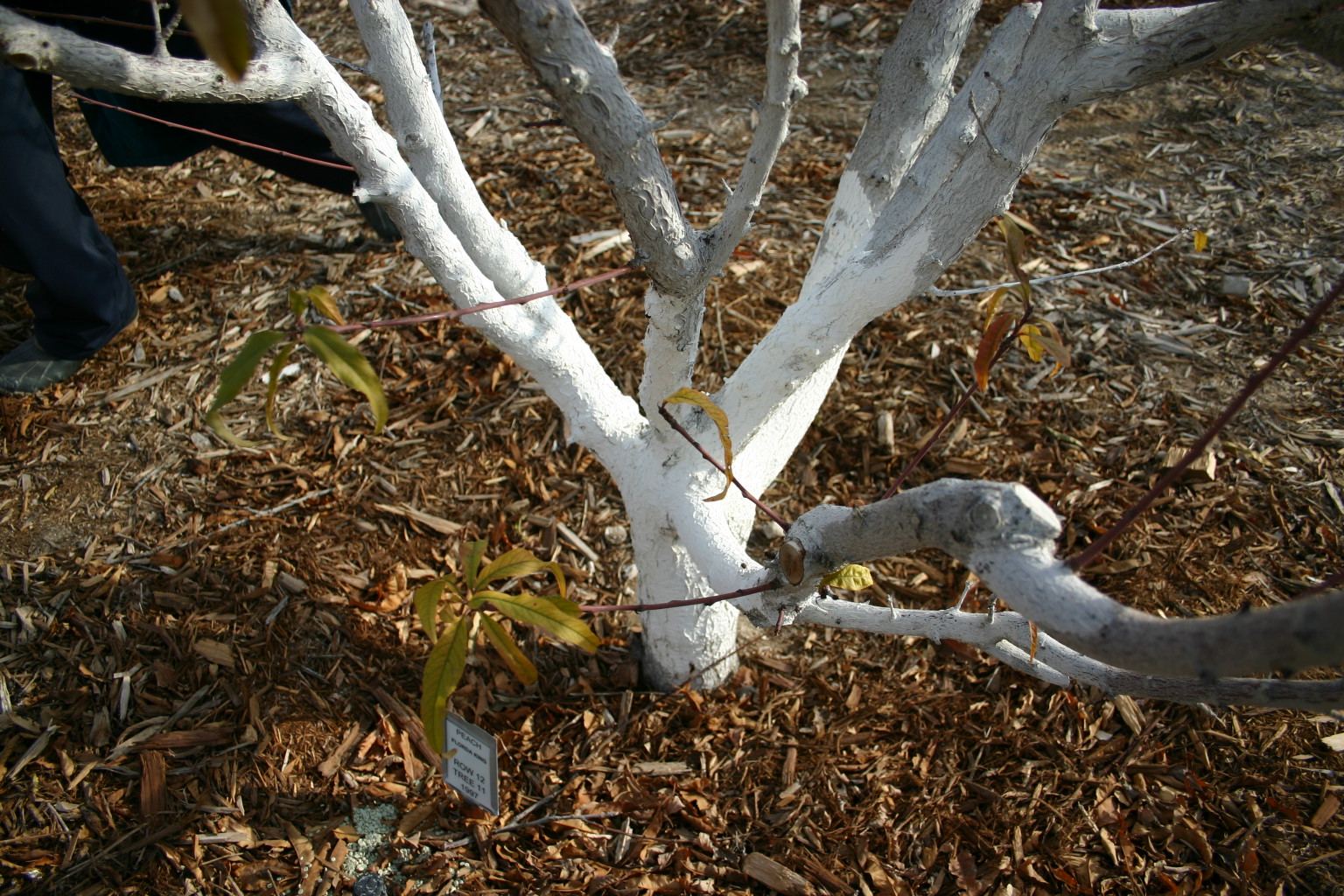
Fruit trees painted with whitewash paint
     Alum was sometimes added as a hardener to prevent the coating from rubbing off.
     Carbolic acid was sometimes added to create "sanitary" whitewash.
     Indigo and bluing were popular additives in counteracting the tendency of some binders to yellow.
     Whitewash can be tinted; historically, they were tinted with earth pigments, brick or stone dust; currently, lime-fast pigments are recommended.

CHARACTERISTICS

    Adheres best to rough porous surfaces.  It does not adhere well to smooth porous surfaces
    When applied to a surface, the mixture forms a thin opaque film of calcium carbonate (plaster).

ADVANTAGES

    Fairly easy to make.
    Non-yellowing (because there is no oil binder).
    Less expensive than other finishes.
    Effective in adhering to masonry surfaces.
    Considered a "sanitary" coating exhibiting disinfectant qualities (i.e. sometimes used to retard the decay of wood).
    Somewhat effective as a fire retardant and thermal insulator when applied in thick layers. (Not recommended to apply in thick coats for fruit trees)

USES

    Historically used on the exterior to reflect heat.
    Also, historically used to protect fruit tree trunks from frost and insects.
When properly mixed and applied, new growth has no trouble getting through a thin layer of whitewash

MIXES

NOTE:  This mix has good adhesion and chalk resistance.  It can also stand covered for several days before using.

    Make the lime paste by soaking 50 lbs. of hydrated lime in 6 gallons clean water
                                                   - OR -
    Slake 25 lbs. of quicklime in 10 gallons of boiling water.  Either combination will make about 8 gallons of paste.
Dissolve 15 lbs. of salt or 5 lbs. dry calcium chloride in 5 gallons of water.
Combine with lime paste and mix thoroughly.  Thin with fresh water as necessary.

GENERAL NOTES

   Before whitewashing any surface, gently wash the surface with vinegar.
   Be sure that brushes and pails are clean; be sure to strain the wash.
   Always slake the lime with boiling water and cover container with sackcloth or burlap to keep in the steam.
   Never let the lime dry up - when the lime has broken up, keep covered.
   When the lime has thinned to the right consistency, add 2 tablespoons of salt to each pail of wash.
   Add pigments if desired to achieve color.

Whitewash can be applied using sprayers or with a brush

Viragrow Delivers!

Viragrow Has Certified Playground Material for Children's Play Areas

Q. Do you sell a certified Playground Material for play areas?


A. I am taking the following information directly from Viragrow’s website and can be found at
Viragrow’s playground material is the last entry on this webpage.

Taking the information directly from the website, You can see a picture of this material on the website and here.

Certified Playground Material (Mulch)

Available by the cubic yard or cubic foot

Meets Health District requirements as a certified playground material. Northern Utah sawmill wood is shipped in directly and chipped with a specialized wafer grinder. Only untreated and unpainted wood is used to produce a certified safe environment for play.

Certified Playground Material meets ATSM F1292-95 at a 12" of material thickness at temperatures of 30F, 72F and 120F.

Health Department regulations require a minimum of an 8 inch depth upon installation and settling.

I hope this answers your question. If you have any further questions please feel free to email me or call Viragrow at 702-399-3868.

Soft Rock Phosphate May Not Be What You Think It Is

Q. I discovered from the internet that soft rock phosphate apparently does not work in alkaline soil. Does our Las Vegas soil contain any phosphate? I wonder if in long term it can be unlocked with some fungi or something like that. 


Rock Phosphate
Viragrow does not carry rock phosphate. 0-3-0
A. There is some phosphorus in all soils. The question becomes whether there is enough phosphorus in the soil to support what we are trying to grow.
            When we grow vegetables and fruit trees in soils, these plants take minerals from the soil and store them in their leaves, flowers and fruit, stems and roots. We eat roots, stems, leaves and fruits of different plants. This is how we get the minerals in our body to support our health.
            When we grow plants and harvest them, we remove whatever minerals they removed from that soil. These minerals need to be replaced in the soil. We replace them by applying soil amendments like compost or fertilizers or both to these soils.
            Some minerals are needed in large amounts by plants while others are needed in small amounts. Phosphorus is needed in large amounts. When we intensively grow vegetables and fruit in a small area and harvest them, nutrients need to be put back in the soil.

            Phosphates found in fertilizers provide enough phosphorus for most plants. Adding 
Viragrow carries traditional Triple Super Phosphate and Bone Meal
compost to the soil supplies the microorganisms needed to help plants use this phosphorus. As long as the soil is healthy and vibrant by using amendments such as good quality compost, the type of phosphorus added will not make much difference.

Rock phosphate is considered an "organic" source of phosphorus even though there is nothing "organic" about it. It comes from minerals found in the soil. This points out some of the confusion regarding the word "organic" when it comes to gardening. Many composts have phosphorus in the "organic" form including composts made from biosolids. Who knows where these "rock phosphates" come from and what they have in them that may or may not make them acceptable for "organic" gardening.


Viragrow Delivers!