Monday, May 6, 2019

How to Make and Use Compost Tea

Spraying compost tea will deliver plant nutrients to the plant to keep it healthy, promote growth and protect it from diseases by applying "antagonistic" microoganisms on the leave surface.

Compost tea can be made from Viragrow 166 Compost or our Organic Compost Here's how.

Soak Compost in Clean Water

Tap water is fine to use. Soak about two cups of Viragrow 166 Compost or Organic Compost in a five gallon container of water overnight. I like to use this compost tea ball because it keeps the fine particles out of the water. It's over 5 inches in diameter. We use enough compost in it to fill the bottom part and then soak.


Fine particles from the compost can plug a sprayer if you don't use some sort of filter. The holes in the tea ball seems to be small enough to filter the water for most sprayers. Alternatively you can use a cotton sock and put about two cups of compost in that and soak it in the water. The compost can still be used after it has released a bunch of plant nutrients and microoganisms. The cotton sock filters the compost even more than the tea ball does.

Dilute the Compost Tea

The level of nutrients in the water is too rich for most plants. These levels of nutrients should be diluted to make it safe to spray on plant leaves. Mix the same amount of clean water with your rich compost tea. This dilutes the nutrients enough to make it safe to spray on most plant leaves. If you want to do some checking to make sure, the salt level of the final spray should be between 3 -4 mmhos/cm or less than 2500 ppm. There is about 650 ppm for each mmho/com. Use a salt meter to check it. Salt meters like they use for salt water aquariums will work and they are not that expensive.

Link to a salinity meter

Mix in a Spray Adjuvant

Spray adjuvants help move past the resistant surface layer of leaves and inside the leaf. Plant nutrients move directly inside the leaf and dont have to be transported that circuitous path from roots, through stems and finally to the leaves. An excellent spray adjuvant for doing this is Viragrow's EZ Wet. Use one teaspoon per gallon of spray solution. Its made from Yucca extracts.

Spraying Compost Tea on Plant Leaves

A compost tea solution sprayed on plant leaves will fertilize and protect plants from many different diseases. Spray only enough to thoroughly  wet the leaves and no more. Repeat this spray to plant leaves every 30 days if you want to promote growth. Spray bottles will work if you have only a few plants to spray or use a compressed air sprayer.

Storage of Compost Tea

Compost tea will stay fresh for about two weeks in a refrigerator before the microorganisms begin to fail. After that it still works as a "fertilizer spray" but loses its potency for disease protection.

Monday, April 22, 2019

Applying Rock Phosphate to Our Soils


Q. I discovered from the internet that soft rock phosphate apparently does not work in alkaline soil. Does our Las Vegas soil contain any phosphate? I wonder if in long term it can be unlocked with some fungi or something like that. 
Rock Phosphate
Viragrow does not carry rock phosphate. 0-3-0


A. Rock phosphate is considered an "organic" source of phosphorus even though there is nothing "organic" about it. It comes from minerals found in the soil. This points out some of the confusion regarding the word "organic" when it comes to gardening. Many composts have phosphorus in the "organic" form including composts made from biosolids.Who knows where these "rock phosphates" come from and what they have in them that may or may not make them acceptable for "organic" gardening.
A. There is some phosphorus in all soils. The question becomes whether there is enough phosphorus in the soil to support what we are trying to grow.
            When we grow vegetables and fruit trees in soils, these plants take minerals from the soil and store them in their leaves, flowers and fruit, stems and roots. We eat roots, stems, leaves and fruits of different plants. This is how we get the minerals in our body to support our health.
            When we grow plants and harvest them, we remove whatever minerals they removed from that soil. These minerals need to be replaced in the soil. We replace them by applying soil amendments like compost or fertilizers or both to these soils.
            Some minerals are needed in large amounts by plants while others are needed in small amounts. Phosphorus is needed in large amounts. When we intensively grow vegetables and fruit in a small area and harvest them, nutrients need to be put back in the soil.
            Phosphates found in fertilizers provide enough phosphorus for most plants. Adding compost to the soil supplies the microorganisms needed to help plants use this phosphorus. As long as the soil is healthy and vibrant by using amendments such as good quality compost, the type of phosphorus added will not make much difference.

Avoid Nematodes With This Simple Gardening Method

Container gardening uses a wide assortment of plastic, ceramic and wooden containers to hold the growing medium for plants. If the growing medium, or soil, becomes contaminated or exhausted of nutrients and is no longer productive, it is easier to  rectify the problem in the soil or, in some cases, simply dispose of it and start all over.


Tomatoes growing in 5 gallon nursery containers
Such is the case with nematodes.Once garden soils become contaminated with nematodes they are next to impossible to get rid of.

Nematodes damage on tomato roots
Soils in containers isolate problems from the garden. Soils can become contaminated because of chemicals, damaging nematodes and noxious weeds that are difficult to control. It is just plain easy to garden in containers.

Here are some simple guidelines to follow when growing plants in containers.

  1. Pick a container that is large enough for the plant or plants.  5 gallon nursery containers are about the smallest container I would want to use in our climate. Containers should have holes at the bottom to allow water to drain. Our climate is hot and dry in the summer and there is not enough soil in small containers to hold the water needed by plants throughout the day. Secondly, soils in small containers heat up rapidly during the summer months.
  2. Sanitize the inside of the container before planting. One of the best sanitizers is a 10% solution of Clorox in water. A 10% solution can be made with one cup of Clorox combined with 9 cups of water. Make sure the Clorox solution is in contact with the inside of the container for at least two minutes. Make sure the container thoroughly dries in the open air before planting. Another great disinfectant is our warm, dry air. A hair dryer on the hot setting does a pretty good job of sanitizing as well. More information on Clorox bleach
  3. Use good quality planting soil. Plant health is directly related to the environment where it lives and how it is managed. Unless you are experienced with gardening and soil management, it is best to use a manufactured soil medium. Fill the container with the soil medium and water it thoroughly to settle the soil. Do not put gravel, rocks or shards of clay pots at the bottom of the container to improve drainage. They will not do that. Irrigate until water comes out of the holes at the bottom of the container. Remove or add soil until the top of the soil is about 1 inch below the top of the container.
  4. Reduce the heat load of the containers. Nursery containers are usually black in color. In our intense sunlight these nursery containers can transfer a lot of heat to the soil inside the container. If these containers are in full sun all day long, the soil can get quite hot and damage the roots of plants growing in it. It is best to either change the color of the container to white by painting it or put the container inside an outer container so that it is shaded. If you choose to put a container inside another container, put a layer of pea gravel at the bottom of the outer container so the inner container is elevated above any standing water and does not get lodged in the outer one.
    Pepper growing in 6 gallon nursery container with mulch
Did you know that Viragrow sells a variety of soils for different purposes. These soils can be purchased in bulk or you can load them into your own bags. Viragrow makes the best soils in southern Nevada!

Fixing Yellow Citrus Leaves

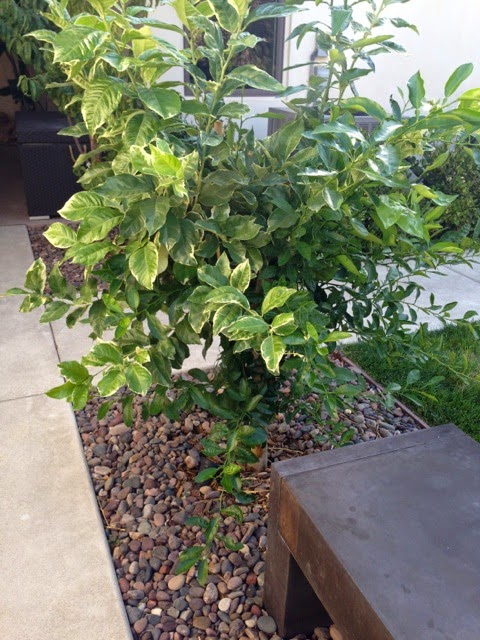
Yellow leaves of citrus is a common problem in our desert environment and growing in our desert soils. The reasons for yellowing can be several.

Yellowing of citrus leaves is common when growing in desert soils.

Fertilizer deficiency. Sometimes yellowing is caused by a lack of a plant nutrient in the soil or the soil may be too harsh for the plant. We can either add nutrients to the soil or improve the soil and help the plant take up that nutrient. The usual nutrient problems for citrus are iron, manganese or magnesium. It's possible it could be all three. 

Apply iron. We carry the best iron chelate to apply to desert soils, EDDHA iron chelate. Apply this to the container soil or next two drip emitters and wash it into the soil lightly close to the roots.
EDDHA iron chelate, the best chelate for desert soils.

Apply magnesium. Sometimes a lack of magnesium can be the problem particularly in container soils. Try Sul Po Mag for correcting magnesium problems and also adding potassium to the soil.

Sul Po Mag fertilizer

Magnesium deficiency of citrus

If your container soils are old you should repot the citrus tree during warm weather. Gently remove the plant from the container and wash the roots and the container, removing the old container soil. Repot the tree with Viragrow Garden Soil Mix or container mix.


Viragrow Delivers!

Soil Science Society of America: Soils Support Urban Life

There are many ways urban residents can help their soil get healthy and work well
Jan. 20, 2015—The Soil Science Society of America (SSSA) is coordinating a series of activities throughout 2015 International Year of Soil (IYS) to educate the public about the importance of soil. February’s theme is “Soils Support Urban Life.”

In the US, over 80% of the population lives in cities or suburbs. While the downtown areas of cities are covered with asphalt and concrete, there are still lawns, trees, gardens and parks. Under all of this “city space”, even under the concrete, is soil. Soil a complex mixture of minerals, water, air, and organic matter that performs many critical functions.

SSSA recommends that urban dwellers consider rain gardens for their yards, and compost their appropriate food wastes. The SSSA website, Discover Soils, has a “Soils in the City” section 
(https://www.soils.org/discover-soils/soils-in-the-city) with instructions for setting up community gardens.
“Our main goal during International Year of Soils is to help educators and the general public understand this natural resource,” according to David Lindbo, SSSA’s IYS task force leader. “Soil provides for us and regulates our world. We need to take care of it in return…because soils sustain life.” 

As part of their celebration of IYS, SSSA is developing a series of twelve 2-minute educational videos. They are working in conjunction with Jim Toomey, author of the environmental cartoon, Sherman’s Lagoon. February’s Soils Support Urban Living video can be viewed at www.soils.org/iys/monthly-videos. Education materials can be viewed atwww.soils.org/iys.

Follow SSSA on Facebook at https://www.facebook.com/SSSA.soils, Twitter at SSSA_Soils. SSSA also has a blog,Soils Matter, at http://soilsmatter.wordpress.com/. Additional soils information is on www.soils.org/discover-soils, for teachers at www.soils4teachers.org, and for students through 12th grade, www.soils4kids.org.

The Soil Science Society of America (SSSA) is a progressive international scientific society that fosters the transfer of knowledge and practices to sustain global soils. Based in Madison, WI, and founded in 1936, SSSA is the professional home for 6,000+ members and 1,000+ certified professionals dedicated to advancing the field of soil science. The Society provides information about soils in relation to crop production, environmental quality, ecosystem sustainability, bioremediation, waste management, recycling, and wise land use.


How to Apply Iron Chelate to the Soil

Iron chlorosis of photinia
Some plants need iron when growing in our desert soils while others do not. Plants that need iron applied to the soil or leaves will develop yellowing. This yellowing of the leaves will frequently, but not always, leave the veins of the leaves a green color. In extreme cases, the leaves turn all yellow and will begin to scorch at the tips and edges.

If your plants were this color last year they need iron applied to the soil in the month of February. The best iron product to apply to the soil and correct this problem in the coming months is the iron chelate called EDDHA.
Iron chlorosis of bottlebrush

It is very simple to apply this chelate and a small amount is needed per plant. Fill a 5 gallon bucket with two or 3 gallons of water and add about 2 ounces of EDDHA chelate and mix. The chelate is safe to handle but you should still wear gloves and keep it off of your clothes.

Apply this mixture directly to the soil or mulch at the base of the plant and lightly water the area with a hose to move the chelate into the soil closer to the roots. You are done!


Viragrow Delivers!

Soils Support Agriculture

Soil Science Society of America wants you to know 

Soil is the ultimate source of the nutrients our bodies need

Feb. 23, 2015—In celebration of the International Year of Soil 2015 (IYS), the Soil Science Society of America (SSSA) is coordinating a series of activities throughout to educate the public about the importance of soil. March’s theme is “Soils Support Agriculture.”
Here are a few facts about soils and agriculture:
  1. Soils support agriculture by serving as the foundation of where we grow our food.
  2. Virtually everything in our diets either directly or indirectly came from the soil.
  3. The nutritious calcium found in broccoli is not only good for humans, but it was necessary for the broccoli plant to grow, too. Plants use calcium to help with cell division, and for getting other nutrients from the soil.
  4. Some plants, like alfalfa, not only grow in the soil, but add nutrients back to the soil.
As part of their celebration of IYS, SSSA is developing a series of twelve 2-minute educational videos. March’s Soils Support Agriculture video can be viewed at www.soils.org/iys/monthly-videos. The American Society of Agronomy co-sponsored the video. Educational materials can be viewed atwww.soils.org/iys by clicking on the March tab.

Follow SSSA on Facebook at https://www.facebook.com/SSSA.soils, Twitter at SSSA_Soils. SSSA also has a blog, Soils Matter, at http://soilsmatter.wordpress.com/. Additional soils information is onwww.soils.org/discover-soils, for teachers at www.soils4teachers.org, and for students through 12thgrade, www.soils4kids.org.

The Soil Science Society of America (SSSA) is a progressive international scientific society that fosters the transfer of knowledge and practices to sustain global soils. Based in Madison, WI, and founded in 1936, SSSA is the professional home for 6,000+ members and 1,000+ certified professionals dedicated to advancing the field of soil science. The Society provides information about soils in relation to crop production, environmental quality, ecosystem sustainability, bioremediation, waste management, recycling, and wise land use.


Viragrow Delivers!

Correct Yellow Leaves Overnight

In our desert soils, yellowing of plant leaves is frequently because of a lack of iron available to plants. Plants need iron to make the green pigment in their leaves, and green stems, called chlorophyll. Even though iron is not a part of chlorophyll it cannot be made without iron. If the chlorophyll is not made, the color of the leaf stays natural. In most cases a leaf's natural color is yellow.


Winter is the time of year when soil applied iron is not going to be effective. Liquid sprays applied to leaves can cause greening in 24 hours or less on warm days. In some cases it could be a bit longer.

iron chlorosis on cherry laurel

Yellowing on citrus

There are three ways of getting available iron inside the plant; applying it to the soil, applying it to the leaves and injecting it into the plant. Applying iron to the soil is best done just before new growth in the spring and through the early summer months. After that time and including the winter the best method is to spray the leaves with a liquid iron spray. Iron injections with products such as Medi Caps or the more sophisticated Mauget technique is also best done in the spring.

Iron sprays to the leaves are best done with any of the iron chelates because they are nonstaining on stucco and cement. It is best to use distilled or deionized water for iron sprays. 

However, if you use tap water from desert regions you must adjust the alkalinity of the water before you make the iron spray. In Las Vegas our water needs to be a bit more acidic or we might lose the effectiveness of the iron spray. The easiest way to adjust the water's alkalinity is to use vinegar. How much to use per gallon of water depends on the alkalinity of the water but usually around 1 to 2 tbs per gallon. You should check it with pH strips to be sure.

The other ingredient you should use with the spray (it will make the spray MUCH more effective) is a wetting agent to help move it through the waxy leaf surface and inside the leaf. EZ Wet is an excellent product for this person and requires about 1 tbs per gallon of spray.
EZ Wet surfactant for helping iron move inside the plant

The sequence you should follow is this:
  • Fill the sprayer with enough water to do the job and no more.
  • Adjust the water with vinegar to a pH of 5.5 to 6.5
  • Add iron chelate according to the label
  • Add EZ Wet to the finished spray
  • Use all of the spray; repeat sprays four or five times every 2 to 3 days until you get sufficient greening
  • Rinse the sprayer

Viragrow Delivers!

Which Iron Should I Use?

Iron chlorosis

Applying Iron the the Soil

Iron products can be applied at any time of the year.

But iron products applied to the soil should be applied before growth starts at the beginning of the year. This is usually in mid January through about March.

Any of the iron products can be applied to the soil. But the chemistry of the soil will determine which of the products will work and which ones will not.

Viragrow's 5 pound EDDHA iron chelate
The only surefire products that will work in all of the different soils are the iron products containing a chelate called EDDHA.

Other products may work if the chemistry is just right but EDDHA has its own chemistry built in that insures that it will work. Only an ounce or two is needed for each plant once a year. But

if you have a lot of plants you should consider saving some money and buying Viragrow's 5 pound bag.

Applying iron to the leaves

The other option is to apply iron to the leaves. Of course this has to be done only when leaves are present. This means that foliar applications of iron are done at times of the year when the problem is developing or has developed.

Any of the water soluble iron products can be used as foliar sprays. On products not containing EDDHA the water pH should be adjusted to pH=7 or distilled water should be used.

The spray will penetrate the leaves much more effectively by mixing a surfactant or wetting agent like EZ Wet in the spray mix before spraying. If you don't use a surfactant then most of the iron
sprays will run off the leaf surface and not penetrate inside the leaf.

When spraying just wet the leaves until you start to see water falling from them. You will most likely have to respray three or four times a few days apart to get dark green foliage.

Iron sprays do not keep for very long so use all of the product and don't mix more than you need.

Viragrow Delivers!

What's the Difference between Compost, Soil Mix and Mulch?

Compost

Compost is made from decomposed or rotted animal or plant remains. It's usually made from what we normally considered to be waste products. It's a way of recycling. Waste products that are chemically safe and that will decompose are added to a "compost pile", or some sort of composting equipment, where these recycled materials can be decomposed by microorganisms.
Composting is the ultimate in recycling

These microorganisms need air, water and warmth to work. If compost is sanitized so that it safe for human use, the compost temperatures rise to about 165° F before it's turned. Turning compost speeds the decomposition up and cools the compost down.
A Windrow Turner turns the compost and a nice pile, aerating it and adding moisture as it's turning it. A compost thermometer is used to judge the timing for turning it. When it hits that critical temperature of 165° F, the compost must be turned.

Turning also adds air to the compost. Water is added to the compost, not too much, just to keep it moist. Microorganisms feed on these wastes breaking them down more and the temperature goes up again. It's turned again so it is aerated and moisture is added.
A compost thermometer reaches into the center of the compost pile and measures its temperature. When that temperature reaches 165° F, it's time to turn it. This kind of heat destroys pathogenic microorganisms while turning it redistributes microorganisms back into the compost pile again.

When the composting is near completion, temperatures to not get as hot as they do did before even when it's turned. Microorganisms have decomposed as much as they can decompose and now they are dying off. When the temperature reaches about 115° F, the compost can be sold and used.
A good compost should be dark brown or black, look consistent throughout the compost pile and have no funny smells like rotten eggs.


Soil Mix

A Viragrow Soil Mix uses compost and mixes it with soil or a soil component such as sand so that it can be used as a ready-made soil for growing vegetables, planting fruit trees, planting landscape plants, flowers and many other plants important to a landscape. Viragrow does not use reject sand. We consider it to be an inferior sand for landscaping. 

The simplest soil mix is Viragrow Garden Soil which is compost mixed with viragrow sand. Viragrow Garden Soil is a ready-made soil mix for planting all sorts of gardening plants. 


Tomato Lady Soil Mix is a soil mix as well but it has all sorts of organic amendments mixed with it. 
Rejuvenate soil mix

Rejuvenate Soil Mix is Viragrow's "vegan" soil mix and contains no animal products.

Mulch

Mulch is applied to the surface of the soil to prevent weed growth, conserve soil moisture, improve the soil and beautify the landscape. Viragrow mulches are made from natural forest products. They include redwood, sequoia and pine. Some of Viragrow's mulches are below. Call 702-399-3868 and ask us about our other mulches.


Saturday, March 23, 2019

Heavy Metal Concerns in Compost Made from Municipal Solid Waste

Viragrow thought this Fact Sheet from Cornell Composting might be interesting to those who have concerns about heavy metals and human health.

http://compost.css.cornell.edu/MSWFactSheets/msw.fs4.html


Sunday, October 14, 2018

Better Mulch Than Woodchips around Vegetables Is Animal Bedding


Q. I use woodchips around my vegetables, fruit trees and landscape plants. When I turn it over after the first freeze, what should I add to counter the effects of rotting wood?
Woodchip mulch can be difficult to find because it comes directly from tree trimmers who chip wood from local trees. This is usually taken to landfills in Nevada where it's dumped. Too bad. It's a valuable resource in soils that have no organics in them like the Mojave Desert soils.

A. That is a drawback to woodchip mulch used around vegetables. Older information recommends straw mulch around vegetables but that can be weedy, doesn’t rot very quickly and can be difficult to turn over and mix in the soil. Straw decomposes slowly in the soil.
Viragrow's  Red Star Mix & Mulch Will Work

             Use woodchips on soil surfaces around plants that don’t need the soil turned over every year such as fruit trees and ornamentals. No need to turn it over. Woodchips rot from the bottom as long as it is in contact with wet soil. Replenish it by adding it to the surfaces of these areas. Four to six inch depth is ideal.
            Better to use a surface mulch that decomposes quickly around vegetables and herbs like shredded newspaper, grass clipping and even sawdust. But my favorite is pine shavings sold for animal bedding. It is shaved pine mostly and decomposes quickly in moist soils.
Animal bedding like this clean and cozy horse bedding works best for vegetables because it's made of pine shavings. These disappear in the soil much faster than straw or woodchips around vegetables.
            Spread only enough to shade the soil surface to keep it cool and shade it; maybe ¼ inch deep or a bit more. It “dissolves” in the soil quickly during warm weather. I use it to cover the soil surface when germinating seed or planting transplants in raised beds during the hot and warm months.
Pine shavings such as animal or horse bedding works great as a mulch and vegetable beds because it decomposes so rapidly and poses no problems when it's turned under.

            If you’re not vegan, used animal bedding is valuable because the nitrogen from the manure and urine is already mixed in it and prepares the wood shavings for decomposition. Otherwise decomposing pine shavings “gobbles up” some of the soil nitrogen when it rots. Not a huge problem but this can happen if the soil is kept on the “lean” side from a lack of added nitrogen to the soil.
            Did you know tons of horse bedding is taken to landfills in Las Vegas? Horse bedding makes a great soil amendment. Lost gardening resource and these horse owners are looking for ways of getting it used rather than dumping it. Sounds like an opportunity.
            Rake the woodchips aside when planting or replanting vegetables. Spread it back around the plants again after planting. You only need enough room to dig holes for transplants or for direct seeding. Once the plants are up and growing, the mulch can be put back.

Monday, August 20, 2018

Why Some Iron Products Work and Others Not

Q. I see you mention a specific iron product every year, but I decided to buy it for use early next spring. We prefer to buy it online. When I searched for it, about 80 choices appeared and now I am confused.

A. Not many places stock this iron fertilizer locally. Helena Chemical and Viragrow are the only places I know locally that carry it locally. 
            I have been waiting for an excuse to explain this iron dilemma more thoroughly. Using the wrong iron product when the chemistry of the soil or water is not right, results in a waste of time and money.
            The chemistry of our desert soils is responsible for most yellowing seen in plant leaves. You are right, there is a huge variety of iron products available. Which one to use? The problem is not with the product. The problem is matching the product to our soils because of their chemistry.       
            There are two methods for applying iron to yellow plants; a single application to the soil in early spring or 3 – 4 applications of an iron spray directed toward yellowing leaves later in the season.
            A single iron fertilizer application to the soil makes green leaves continuously as the plant grows through the year. Multiple sprays of iron to the leaves is the only method that corrects leaves already yellow. Each spray, a few days to a week apart, makes the leaves darker and darker.
            All iron fertilizers work IF the soil pH (which is related to its alkalinity) is 7.5 or lower. If an iron product is applied to the soil and expected to work, the soil pH must be 7.5 or lower. If an iron product is mixed with water and sprayed on the leaves, the pH of the water must be 7.5 or lower. The magic number to remember is 7.5. Most desert soils and our water supplies are closer to 8. This becomes a problem for all iron products except one.
EDDHA iron products at Viragrow. 1 pound container top
and 5 pound package on bottom.
            Iron fertilizers that contain the chelate EDDHA are 100% effective with any amount of alkalinity. That’s right, any amount. But the chelate in the ingredients MUST be EDDHA.
            When applying iron fertilizer to soils in early spring, just before new growth appears, use an iron fertilizer containing the chelate EDDHA. It will tell you so in the ingredients.
            Later in the growing season when leaves begin yellowing, all iron fertilizers sprayed on the leaves work IF the pH of the water is below 7.5. Use distilled water or water from reverse osmosis. This water has little alkalinity and a pH of 7.
            It’s difficult to get iron sprays inside the leaves. Leaves have no roots, so we must improve the movement of this iron spray inside the leaf. This is done by “making the water wetter”. Adding a liquid detergent to the spray at the very end of mixing helps movement of the iron inside the leaf.

Tuesday, August 7, 2018

Best Soil for Bamboo

Q. In a couple weeks, I'll be planting a tropical clumping bamboo in 80ft of planters. I've read the plant prefers sandy loam on top of peaty soil. From my novice experience, I'm thinking this means l will first create a layer a soil with plenty of organic matter, and then top it with sandy loam. Do you sell these two things? Also, I believe I'll need a compost to mix in the loam as I'm planting the bamboo.

I've heard nothing but amazing things about your tomato lady soil from a good friend of mine, and hope you will be able to help me have a green thumb!


A. You can create this soil layering if you want and we have products to do it but growing a clumping bamboo is not so difficult. Using our Garden Soil Mix as a backfill for your bamboo will work just as well and less expensive. 
Viragrow Garden Soil

The biggest worry with clumping bamboos are their tolerance to freezing temperatures. Most of these types of bamboos are sensitive to freezing temperatures. With some mulch covering the soil during the winter they will easily regrow from the base if these temperatures occur. 

Bamboo growing in Las Vegas

If it were me I would save your money and use either Garden Soil Mix or Tomato Lady Soil Mix which has more added ingredients than the Garden Soil Mix.

Picking up more tomato lady garden soil from Viragrow

Thursday, July 19, 2018

Compost Has No Shelf Life if Dry


Q. I purchase ViraGrow compost a cubic yard at a time and bag it myself using black plastic contractor bags which I store in a location that gets some morning sun but afternoon shade. Does compost stored like that have a shelf life? I plan to gradually apply it around plants as time permits but it may take me most of the summer to finish the project.


Which brings up my second question. Is it ok to apply compost to plants all summer despite the heat? 

A. Yes, the Viragrow compost, any compost, does not have a shelf life. In fact, compost improves during the first six months after it has been made and finished. The process is called “curing”. After this it is the same for many months as long as it is dry. Wetting compost doesn’t really make it bad, it just washes some of the nutrients out of it. Leaches.


Notice the leachate coming from the compost. These are the nutrients leaching from the compost. Compost tea if you like.
As far as use of it during the summer months I would be a bit careful. Viragrow compost is very rich in nutrients. That is what makes it unique and separates it from other composts. Because it is rich in nutrients (fertilizer content) it is much like a fertilizer and can “burn” plants if applied during summer months if you are not careful. I would not apply it to vegetables, leaves of plants or flowers during the heat of the summer. It should be applied before this time or after. Then it is fine to apply to plants during cooler times of the year.


Fertilizer in 1 Cubic Yard of  Viragrow Compost

Did you know if you bought all the fertilizers found in Viragrow Compost it would cost $229.41! These are fertilizers not found in perlite, vermiculite, peatmoss, rice hulls and coconut coir!


Fertilizer contained in one cubic yard of Viragrow compost:
3.73 pounds quick release nitrogen = 17.6 pounds of 21-0-0                     $  22.34
7.2 pounds slow release nitrogen = 129 pounds of Milorganite                 $107.50
15.13 pounds P205 = 33.6 pounds of 0-45-0                                              $  45.40
1.5 pounds K20 = 2.5 pounds of 0–0–60                                                    $    8.50
7.1 pounds sulfur = 7.5 pounds of water-soluble sulfur                             $  16.12
16.59 pounds iron = 83 pounds of iron sulfate                                           $  24.55
1.25 ounces manganese =                                                                           $    5.00 trace elements
                                                                  Total fertilizer value                  $229.41


Fertilizer in perlite                                                                          $0
Fertilizer in vermiculite                                                                  $0
Fertilizer in peat moss                                                                    $0
Fertilizer in coir                                                                              $0
Fertilizer in rice hulls                                                                     $0

You can use Viragrow compost as a compost tea, using it as a fertilizer and for disease control, by spraying a “tea” solution on the leaves but again during cooler times of the year. If done, it must be diluted with water just like any compost tea, before spraying it on plant leaves during the spring and fall months. I would dilute it at least 1:1 with water before spraying it as a compost tea. By the way, compost tea does have a shelf life so use it quickly (24 hours) after you make it. The compost that remains after making compost tea is still a wonderful addition to soil to improve it. It just doesn’t contain as much fertilizer because it was flushed into the tea.